The Fall & Renaissance of Lafayette Square
From Gilded Age grandeur to abandonment and, ultimately, an extraordinary architectural rebirth.
The End of an Era | 1896
By the late nineteenth century, Lafayette Square had become one of St. Louis's most fashionable residential neighborhoods. Magnificent Italianate and Second Empire mansions surrounded Lafayette Park, home to the city's prominent merchants, industrialists, and civic leaders.
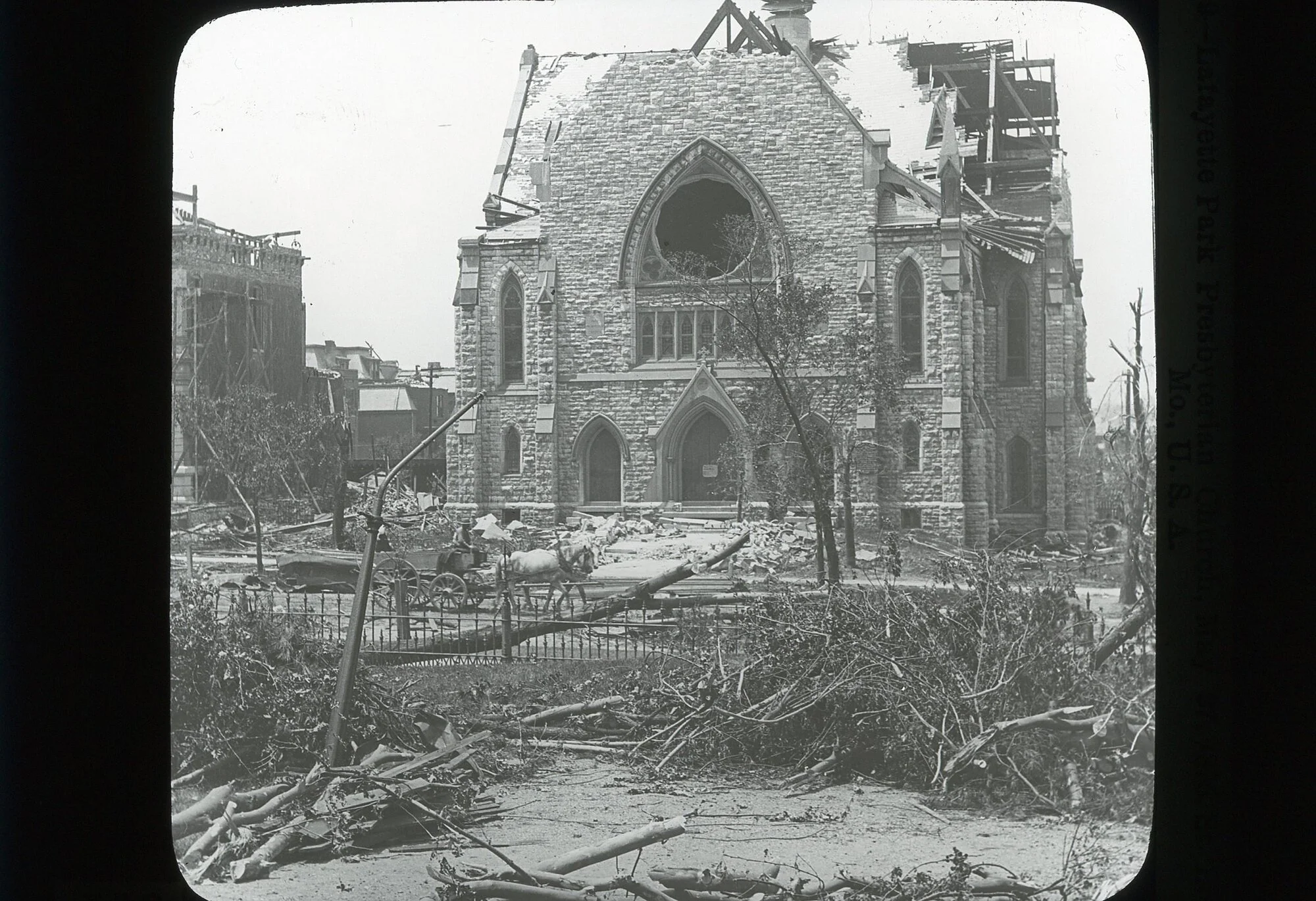
That prosperity was dramatically interrupted on May 27, 1896, when a devastating cyclone swept through St. Louis. The storm ravaged Lafayette Square, destroying homes, churches, and much of the beloved park's landscape. Towering trees were uprooted, ornamental structures disappeared, and the neighborhood's once-celebrated grandeur was profoundly altered.
Although many residences were rebuilt, the neighborhood would never quite recover its former standing. Affluent families increasingly moved westward, following the city's expanding boundaries and newer fashionable districts.
A Century of Change | 1900–1960s
Over the following decades, Lafayette Square underwent a remarkable transformation. Once-grand single-family mansions were divided into apartments and rooming houses. Elaborate interiors were partitioned, architectural details were concealed or removed, and many properties gradually fell into disrepair.
The Great Depression, changing patterns of urban development, and the construction of nearby highways further accelerated the neighborhood's decline.
By the 1960s, many of its distinguished nineteenth-century residences stood vacant or deteriorating. Some were demolished altogether, their architectural craftsmanship lost to time.
Yet beneath decades of alterations and neglect, the bones of a remarkable neighborhood remained: soaring ceilings, carved woodwork, marble fireplaces, ornate plasterwork, and streetscapes that still recalled the grandeur of another century.
The Renaissance | 1960s–1970s
Lafayette Square's remarkable revival began with a small group of preservation-minded residents who saw possibility where others saw decay.
Beginning in the late 1960s, these early restorationists purchased neglected Victorian houses and undertook the painstaking work of returning them to their former beauty. Their efforts extended beyond individual residences, becoming a movement to preserve the architectural and cultural identity of an entire neighborhood.
The establishment of the Lafayette Square Restoration Committee helped unite this growing community around a shared vision. In 1972, Lafayette Square became St. Louis's first locally designated historic district, securing important protections for its extraordinary architectural heritage.
What followed was one of the city's most remarkable neighborhood revitalizations—a testament to the transformative power of historic preservation.
A Legacy Continued | Carré Lafayette
Our home on Missouri Avenue is part of this larger story.
Built in 1882 for John C. Vogel and designed by George I. Barnett, the residence has witnessed the changing fortunes of Lafayette Square, from its nineteenth-century prominence through generations of adaptation and renewal.
Today, we see ourselves not simply as homeowners, but as stewards of a small piece of St. Louis history.
Our approach is rooted in respect for the home's original architecture, an appreciation of European craftsmanship, and the belief that historic houses are meant to be lived in, loved, and thoughtfully preserved for future generations.
Architecture endures when each generation chooses to care for it.
Our Process
Each phase builds on the previous, enabling cumulative insight and continuous optimization.
Articulated objectives
Baseline metrics establish a reference point for subsequent measurement.
Evidence-based insight
Advanced analytics uncover patterns that traditional reviews may overlook.